Why Energy Strategy Matters More Than Ever.
A stable market doesn’t guarantee certainty and that’s why having a clear energy strategy for manufacturers is more important than ever.
Manufacturers now face a complex landscape shaped by:
- Ongoing wholesale price fluctuations
- Tightening carbon reporting requirements
- Increased network and non-commodity charges
- Pressure to improve ESG performance
- Greater scrutiny on operational efficiency
For plastics firms operating on tight margins, relying on outdated procurement methods is becoming increasingly risky.
A modern energy strategy for manufacturers focuses on visibility, flexibility, and long-term planning — not just securing the lowest unit rate.
The Hidden Risk in “Set and Forget” Energy Contracts
Many manufacturers still adopt a “fix and forget” mindset when it comes to energy purchasing. While fixed contracts provide budget certainty, they can also create missed opportunities.
Common issues we see include:
- Contracts rolled over onto uncompetitive rates
- Misaligned purchasing windows
- Limited flexibility when markets fall
- Hidden non-commodity costs
- Volume tolerance penalties
Without regular review, businesses may be paying significantly more than necessary – often without realising it.
An independent review can quickly reveal whether your current contract is still aligned with market conditions and operational needs.
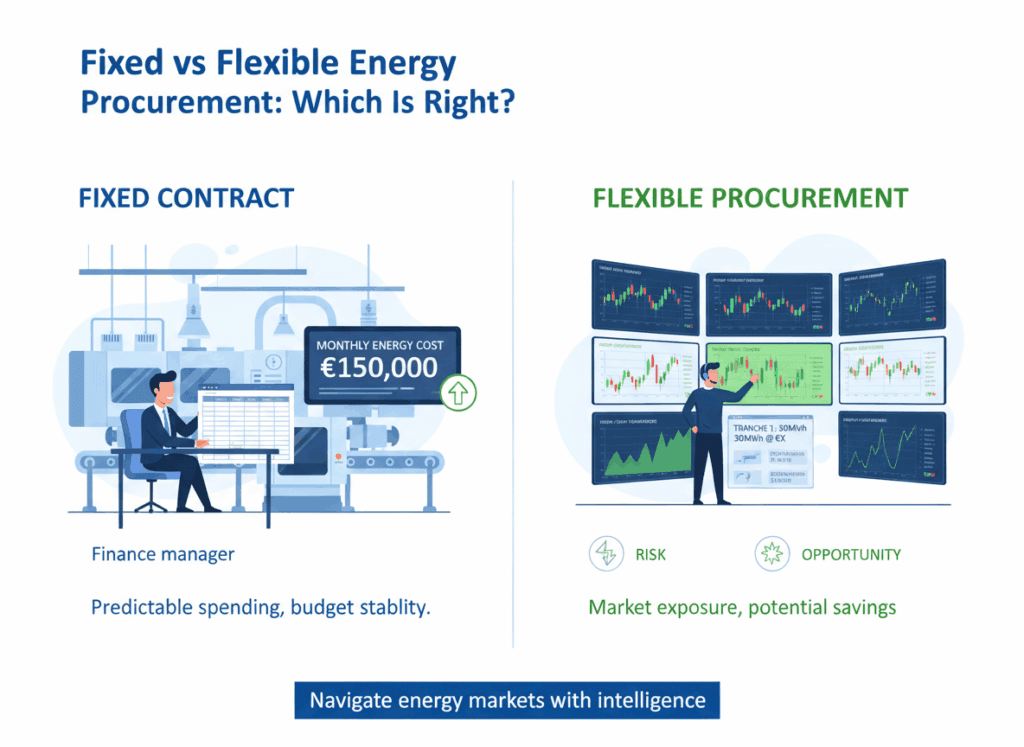
Fixed vs Flexible Energy Procurement: Which Is Right?
There is no universal answer — the right strategy depends on your production profile, risk tolerance, and financial priorities.
Fixed Contracts
Best suited to businesses seeking price certainty and simplified budgeting. However, fixing at the wrong point in the market can lock in higher costs.
Flexible Procurement
Allows energy to be purchased in tranches over time, helping manufacturers respond to market movements rather than committing to a single rate.
For energy-intensive plastics facilities, blended strategies are becoming increasingly popular, combining cost control with strategic buying opportunities.

Visibility Is the Foundation of Cost Control
You cannot manage what you cannot see. A strong energy strategy begins with understanding the following
- How your site consumes energy
- When demand peaks occur
- What charges make up your total bill
- Where inefficiencies may exist
- How your contract performs against the market
This level of insight empowers procurement teams to make confident decisions instead of reactive ones. It also helps eliminate surprises, one of the biggest challenges in industrial energy management.

Energy Strategy and Carbon Reduction Go Hand in Hand
For plastics manufacturers, decarbonisation is rapidly shifting from a future ambition to a present-day expectation.
Customers, supply chains, and investors increasingly want evidence of measurable progress.
The good news is that cost reduction and carbon reduction are often aligned.
Manufacturers are exploring:
- Renewable-backed electricity contracts
- On-site solar generation
- Battery storage solutions
- Demand optimisation
- Energy-efficient equipment upgrades
When integrated into a broader strategy, these initiatives can enhance resilience while supporting sustainability targets.

Why Independent Insight Is Becoming Essential
Energy procurement has grown more complex and many internal teams simply don’t have the time to track markets, analyse contracts, and identify optimisation opportunities.
That’s why independent, supplier-neutral guidance is gaining traction across the manufacturing sector.
Rather than pushing a specific product, an objective review focuses on one question:
Is your current energy strategy still working for your business?
Often, a short assessment is enough to highlight risks, uncover savings opportunities, and provide a clearer path forward.

Take a Smarter Approach with an Energy Health Check
For plastics manufacturers looking to improve cost control and procurement clarity, a structured review is often the best place to start.
The UtilityWorks Energy Health Check is a free, expert-led assessment designed to give manufacturers a clearer view of their energy position.
It provides insight into:
- Contract competitiveness
- Cost-saving opportunities
- Procurement strategy
- Carbon reduction pathways
- Risk exposure
Importantly, it’s independent, supplier-neutral, and entirely obligation-free — focused on practical guidance rather than sales.
Strategy Creates Stability
Energy will likely remain one of the most significant controllable costs within plastics manufacturing.
Businesses that treat procurement as a strategic function — rather than a periodic administrative task — are far better positioned to manage volatility, protect margins, and plan for the future.
A smarter energy strategy for manufacturers doesn’t just reduce costs.
Book Your Free Energy Health Check
If you’re unsure whether your current contract is still competitive or simply want greater visibility over your energy position, a Health Check is a practical first step.
👉 Book your free Energy Health Check today and gain independent insight tailored to the demands of plastics manufacturing. The insight is free. The value could be significant.